
How to check that your ad actually ran in a live stream
Blog/For brands
Influencer marketing on Twitch: formats, streamers, metrics
An agency quoted by Kolsquare puts a Twitch stream at two to seven hours. A classic integration fills only part of that time. That is why influencer marketing on Twitch comes down to three questions: which format, which streamer and how you prove that anyone saw it.
Formats for working with streamers
The guides from Kolsquare and Cyberclick together list these formats:
- Product review or live demo: the streamer uses the product on air and gives their own opinion.
- Unboxing: the streamer opens the product on camera.
- Giveaways that drive attention and engagement.
- Discount codes that encourage people to buy.
- Chat commands (for example, !brand) that automatically post a link or a code in chat.
- Sponsored streams and events: launches, tournaments, talks.
The agencies Kolsquare quotes recommend starting with a pilot campaign and moving on to ambassador partnerships, and they prefer longer formats (shows, original concepts) to one-off mentions.
How to choose the streamer
- Audience quality before follower count. Cyberclick advises looking at the quality of the audience and the engagement, not just follower count.
- Channel theme. It should fit your product and what the streamer already does.
- Country and language. According to Kolsquare, Twitch data is usually filtered by the streamer's language, not by the viewer's country. Always ask for the audience split by country.
How to brief the streamer
Kolsquare's guide and the agencies it quotes give four rules:
- Agree everything before launch: deliverables, timelines and compensation, with an influencer contract in place and the type of placement chosen up front.
- Give guardrails, not a script. Set goals and limits, but leave the creator room for their own ideas: the live, community feel of the platform is what you are tapping into.
- Prepare the streamer fully. A live stream has no reshoot or edit, so the creator needs everything before going on air. Experienced presenters and a thorough briefing reduce the risk.
- Regulated categories. In regulated sectors, one of the agencies recommends using Twitch's own ad products rather than pure live content.
What to measure
Kolsquare suggests four indicators that suit live content:
- Total viewers across the whole stream, not just peak concurrent viewers.
- Average watch time.
- Chat activity and sentiment.
- Reach of clips on TikTok, Instagram and YouTube Shorts.
One answer is missing from that list, and a classic integration doesn't give it: whether the viewer actually saw your brand. With in-stream advertising this is checked on every view: a screenshot, computer vision and 15 parameters against suspicious traffic.
Attribution is simple too: every channel gets its own tracking link by default, and attribution works with AppsFlyer and Adjust, so you can see each streamer's result separately.
Two common mistakes
- Comparing numbers across platforms. Kolsquare advises against putting Twitch's average and peak viewers next to the cumulative views that YouTube or TikTok report. Lead with engagement and audience quality instead.
- Assuming Twitch is only for gaming brands. According to Kolsquare's FAQ, Just Chatting is the most-watched category, and brands in beauty, finance, travel and consumer goods run successful campaigns there.
Six in-stream formats
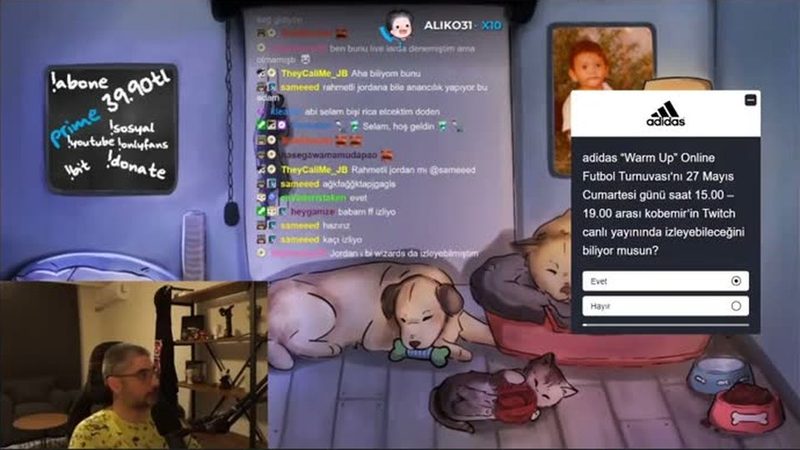
In-stream advertising is more than a banner. APIQ has six formats, all inside the frame and all with a click, a QR code or a link in chat:
- Banner: anywhere on the screen (top, bottom, left or right) on a transparent background. It is shown for 20 seconds. The streamer receives all four versions and picks the one that doesn't cover their camera or the game.
- Full-screen video: up to 30 seconds; a ready-made TV spot works.
- One-third-screen video: present without covering the stream. Together with full-screen video, that's two video formats.
- Interactive poll: the question is announced in chat and the results appear on screen in real time.
- Rich media: a full-screen layer with transparent zones. Your animation moves over the stream and the stream shows through it.
- Stream Takeover: the stream shrinks and your brand fills the frame.
Integration or in-stream advertising?
It depends on what you are after:
| Goal | Streamer integration | In-stream advertising (APIQ) |
|---|---|---|
| Product credibility | Strong: the streamer describes it in their own words | An ad doesn't replace a personal recommendation |
| Reach across many channels | Every streamer is a negotiation | Hundreds of streamers at one CPV rate |
| View guarantee | No | Yes |
| Proof | Streamer's screenshot and report | Screenshot of every view |
You don't have to pick one. An integration with one or two big streamers tells the story; in-stream advertising on hundreds of channels gives it reach. For more on payment models, see CPV, CPM or flat fee.
Followers are not views: what counts is who was watching when your brand appeared.
Brand safety
With in-stream advertising, brand safety is handled in the contract and in the checks. Each streamer signs a contract that forbids advertising next to politics, violence, sex, drugs and other toxic content. Channels are checked automatically: gambling and betting are excluded, and age limits, country and language are verified. You approve the list of channels before launch, can set white and black lists of categories and can remove a streamer during the campaign. A streamer who lands in a scandal is switched off immediately.
Want to see a media plan for your brand?
Get a media planResults from real campaigns
The figures come from client reports on campaigns run in Turkey:
- L'Oréal Paris, Elseve: 367 streamers, 800,127 verified views, 11,762 clicks, CTR 1.47%.
- Migros Hemen: full-screen video on 203 channels and a link in chat; 300,334 views and CTR 2.01%.
In APIQ campaigns, on average about 80% of clicks come from the link in chat, 10% from the QR code and 10% from a click on the screen. The link in chat is not an extra: it is where the audience takes action. All the campaigns are on the case studies page.
Labeling ads
If an integration is paid, it has to be recognizable as advertising. For US and UK rules, see our guide Advertising on Twitch.
Read next